
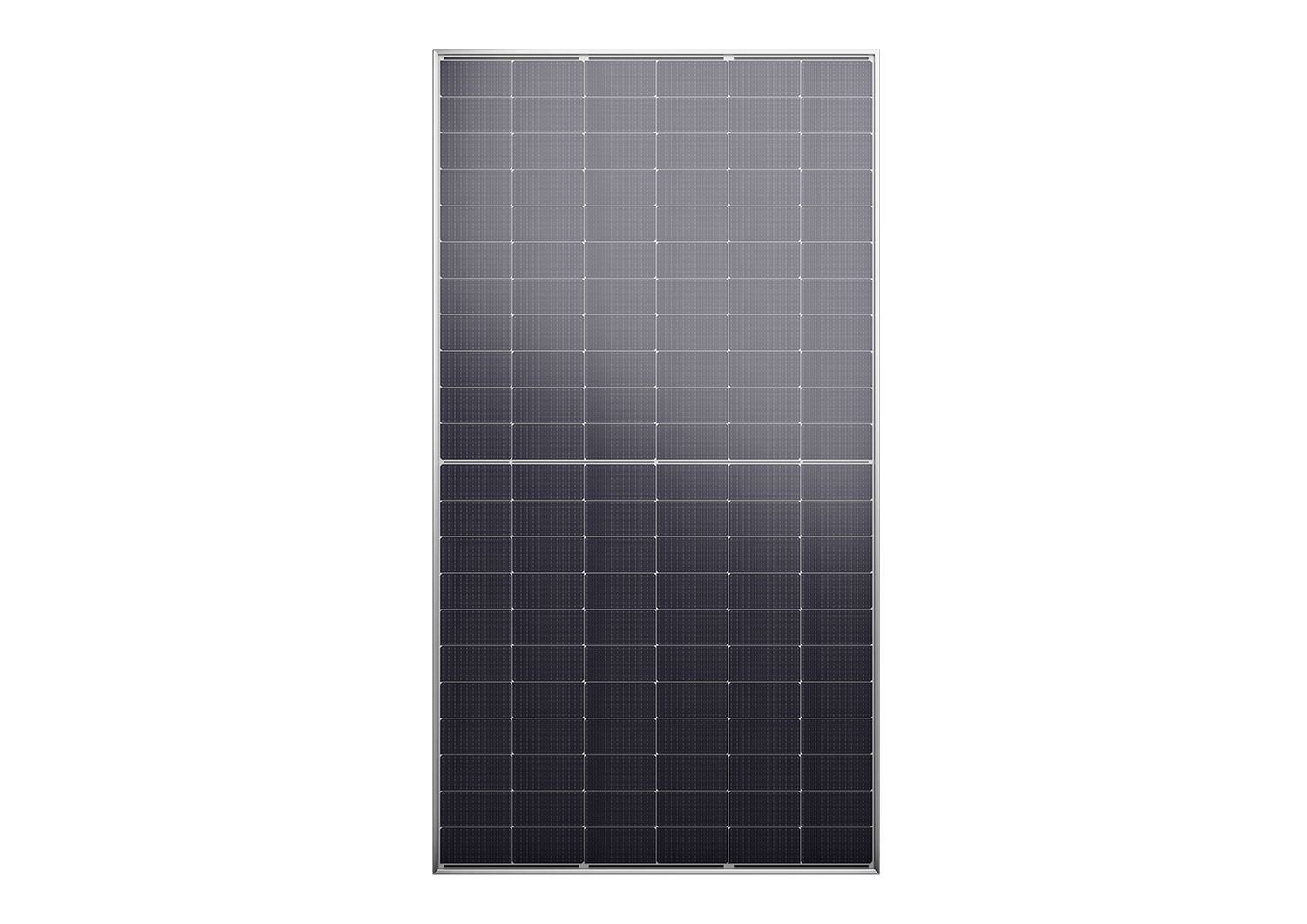
Manufacturer product imagery · configuration may vary
Jinko Solar / Solar panels
Large-format bifacialJinko Tiger Neo 595 W bifacial
A large-format 595 W N-type TOPCon panel with glass on both sides, so it can add output from light reflected onto its back. It is bigger and heavier than a typical home panel, with a 12-year product warranty and a 30-year performance warranty.
Choose your panel
Per panel, including GST. Supply only — installation, mounting and any switchboard work are quoted with your system.
WHY THIS PANEL
595 W per panel, and what that means on your roof.
What it is made of, what it is guaranteed to do, and the figures that decide how many fit your roof and your inverter.
23.03% module efficiency
The share of the sunlight landing on it that becomes electricity. Higher means more output from the same roof area, which matters most when roof space is tight.
N-type TOPCon, bifacial dual glass
N-type cells hold their output better in heat and lose less each year than the older PERC cells. Glass on both sides, and the back of the cell also collects light bounced off the roof.
-0.29 %/C in the heat
Output lost for every degree the cell runs above 25 °C. Closer to zero is better on a Canberra summer roof, when a panel can sit 30 degrees above the air.
0.40% a year after year one
About 1% in the first year, then 0.40% a year: the slow fade every panel has, and what the performance warranty is a promise about.
Key specification
- Model codeThe code on the panel and on your proposal
- Rated powerPmax at standard test conditions
- Module efficiencyShare of sunlight turned into electricity
- Open circuit voltageVoc: decides how many panels fit one string
- Short circuit currentIsc: must sit inside the inverter limit
- At maximum powerVmp and Imp
- Cell layout
- 144 (72 x 2) half-cut N-type
- Bifacial
- Yes, it also generates from light hitting the back
- Glass
- 2.0 mm AR-coated front, 2.0 mm heat-strengthened back
- Frame
- Anodised aluminium
- DimensionsLength x width x depth. This decides how many fit your roof.
- 2278 x 1134 x 30 mm
- Weight
- 31.0 kg
- Connector
- PV-JK03M or Staubli EVO2A
- Maximum system voltage
- 1500 V
- Temperature coefficient of PmaxOutput lost per degree above 25 C. Closer to zero is better.
- -0.29 %/C
- DegradationOutput the panel gives up over time.
- 1% in the first year, then 0.40% a year
- Product warrantyCovers the panel itself: materials and workmanship.
- 12 years
- Performance warrantyCovers how much output the panel still gives you.
- 30 years, at least 87.4% output at the end
- Fire rating
- Class C
- Standards and approvals
- IEC 61215:2021, IEC 61730:2023
Electrical figures are at standard test conditions; the full standards list is on the manufacturer datasheet (open it). We check string voltages against your inverter and your roof before quoting.
What does the wattage actually mean?
It is the panel’s output in full test conditions – 1,000 watts of sunlight per square metre at 25°C. A 440 W panel makes 440 watts at that moment, not all day. Over a year in Canberra each kilowatt of panels returns roughly 1,400 to 1,500 kilowatt hours, depending on pitch, orientation and shade.
Is a higher wattage always better?
Not on its own. A higher-wattage panel is usually physically bigger, so you may fit fewer of them. What matters is the total kilowatts you can get onto the roof, the efficiency per square metre, and whether the voltage and current suit your inverter.
What is module efficiency?
The share of the sunlight landing on the panel that becomes electricity. Higher efficiency means more output from the same roof area – it matters most when roof space is tight.
Why do Voc and Isc matter?
They set how many panels can be wired in a string and whether that string stays inside your inverter’s safe window. Cold mornings push voltage up, so the design has to allow headroom. We check this for your roof before quoting.
What is degradation?
Panels lose a small amount of output each year. A typical modern panel gives up about 1% in the first year and a fraction of a percent each year after, and the performance warranty is the manufacturer’s promise about where that leaves you decades later.
THE PRODUCT, EXPLAINED
What matters in everyday use.
595 W from a single panel
Bifacial rear side adds output from reflected light
2.0 mm glass on both sides
87.4% output guaranteed at year 30
Could it suit your home?
Commercial roofs, sheds, carports and ground mounts where panel size is not a constraint.
Check before you choose
Is the roof structure and access suited to a 2.3 metre, 31 kg panel?
Confirm the exact Australian model, compatibility, installation location and warranty conditions in your final proposal.
THE DETAILS, IN ONE PLACE
Documents, photos & video.
Read the highlights here, then open the manufacturer documents for the detail.
Technical information
Jinko Tiger Neo 72HL4-BDV 575-600 W datasheet (Jinko) ↗Warranty information
Model-specific documents are not yet linked.
Ask us for this document ↗Match the exact model code and Australian configuration to your proposal. Warranty coverage, conditions and exclusions are set out in the applicable manufacturer document.
What customers and the industry say
Don’t take our word for it.
290 reviews
 4.8133
 4.7157
Recognised by the industry
- ★2026Local Solar Hero, ACTSunWiz Awards 2026
- #22026#2 Battery installer, ACTSunWiz Awards 2026
- #22026#2 Solar installer, ACTSunWiz Awards 2026
- #42024#4 Top-rated solar installers, CanberraSolarQuotes 2024
BACKED BY US, NOT JUST THE MANUFACTURER
A 10-year workmanship warranty on solar and battery installations.
Manufacturers cover their products. We cover the installation. For 10 years from practical completion, a defect that comes from our workmanship in installing your solar panels, inverter or battery — the mounting, the cabling, the installation work — is put right by us: repaired, re-done, or the affected installation part replaced, at our cost and at our choice of remedy.
- It stays with the home. Sell up, and the new owner gets the remainder, on the same terms.
- Switchboard, EV charger and heat pump installation work carries its own 1-year workmanship warranty from the date of installation.
- It covers our work, not the products. A panel, inverter or battery fault is a manufacturer warranty matter, with its own period.
- What it does not cover: damage from misuse, changes or repairs by someone else, storms, surges and grid events, pests and corrosion, building movement, ordinary wear, and internet or monitoring problems. A call-out where no workmanship fault is found may be charged.
- Keep your rights. It adds to the Australian Consumer Law guarantees, never replaces them.
- To claim: email engineering@solar4life.com.au or call 1300 997 005 with your name, the installation address, what is wrong and photos. Tell us promptly; delay can affect a claim.
Residential installations. The full terms are in your installation agreement.
Specifications on this page are taken from Jinko Solar’s published documentation for the Australian model. We confirm the exact model, how it works with your existing equipment and the current warranty terms before you accept a written quote.