
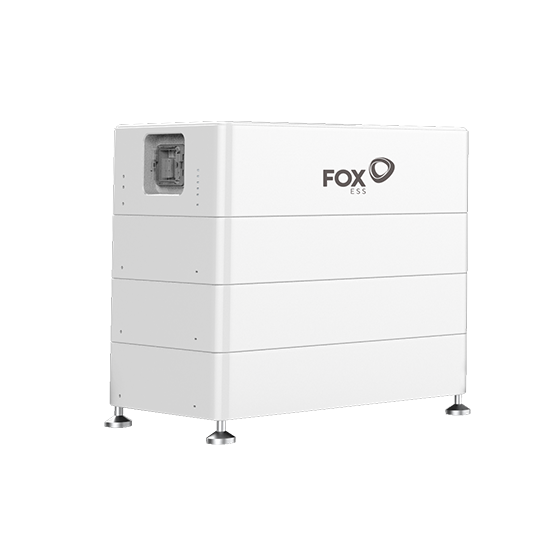
Manufacturer product imagery · configuration may vary
FoxESS / Battery storage
Modular high-voltage stackFoxESS CQ7 battery
The CQ7 is FoxESS's modular high-voltage LFP stack, built from 6.96 kWh modules. These configurations range from 27.84 to 48.72 kWh and include the warm-up function for cold mornings.
Needs a hybrid inverterThis is the battery only. It stores solar and runs your home through a compatible hybrid inverter — FoxESS KH, H1 G2 and H3 Smart hybrid inverters. If you already have a standard solar inverter, we would look at a different setup.
Choose your capacity
Including GST. Supply only — installation, switchboard work, any backup wiring and the hybrid inverter where one is needed are quoted separately.
WHY THIS BATTERY
27.8 to 48.7 kWh, same battery underneath.
Every size in this family uses the same modules, the same chemistry and the same warranty. Adding modules adds storage and, on this design, adds power with it. What changes is how long it runs and how much it can run at once.
Up to 20.16 kW at once
Enough to run most of a house at the same time. Capacity decides how long it lasts; this decides how much can be running.
10 year warranty
Guaranteed to still hold at least 70% of its capacity at the end of the term. It has to stay connected to the internet for the full term to apply.
LFP (lithium iron phosphate)
The cell chemistry, which is what governs how it behaves in heat and how long it lasts. LFP is the safer, longer-cycling chemistry now standard on home batteries.
Expandable
Add 6.96 kWh modules in series, up to 14
Key specification
- Model codeThe code on the unit and on your proposal
- Usable capacityWhat you can actually draw, not the nameplate
- Power at onceHow much of the house can run off it simultaneously
- SurgeWhat it can start — motors draw far more than they run on
- Energy through the warrantyTotal energy guaranteed over the term, whichever comes first
- WeightDecides whether the wall or the floor carries it
- Chemistry
- LFP (lithium iron phosphate)
- Depth of dischargeHow much of the nameplate capacity you can actually use.
- 100% usable
- Round-trip efficiencyEnergy you get back out of what you put in.
- Over 95%
- Weather rating
- IP65
- Where it can go
- Indoor or outdoor, free-standing
- Operating temperatureCanberra winters and west-facing walls both matter here.
- -25 to 55C with warm-up
- Communication
- CAN
Cell detail, voltage windows, fault currents and the full standards list are on the manufacturer datasheet.
How long will it actually run my house?
Divide the usable capacity by what your home is drawing. Most households sit around 0.3 to 0.8 kW overnight and spike to 3 to 6 kW in the evening with the oven, kettle and aircon. So a battery of this size covers an ordinary evening and overnight comfortably, and far less if you are running heavy loads. We size it against your actual bill rather than an average.
Will it keep my house running in a blackout?
Only if backup is specified and wired. A battery on its own does not do it. You need an inverter with a backup output, the backup circuits wired to a separate sub-board, and on some products an extra gateway. Most homes end up backing up essential circuits — fridge, lights, internet, a few power points — rather than the whole house, because the oven and ducted aircon alone can exceed what any home battery delivers.
What is the difference between usable and nameplate capacity?
Nameplate is the energy in the cells. Usable is what the battery management system will let you take out. The usable figure is the honest one and it is what the federal discount is calculated on, so it is the number shown above.
How does the federal battery discount work?
The Cheaper Home Batteries Program is delivered as certificates your installer creates and takes off the invoice up front, so you do not claim anything yourself. It is worth about $265 per usable kilowatt hour at the current rate, and it tapers: the first 14 kWh gets the full rate, 14 to 28 kWh gets 60% of it, and 28 to 50 kWh gets 15%. The rate also steps down over time, so the figure on this page is today’s.
Where can a battery actually be installed?
This is set by the wiring standard, not preference. Batteries cannot go in habitable rooms, ceiling or wall cavities, under stairs or on an escape route, and they need clearance from windows, doors and vents. A garage that is not used as living space, or an external wall out of the afternoon sun, is usually where they end up. We confirm the position on site before quoting.
Should I get a bigger one while the discount is high?
Only up to a point. The discount pays the full rate on the first 14 kWh and only 60% on the next band, so the value per kilowatt hour drops as you go bigger. Past a certain size you are paying close to full price for storage you may only use a few times a year. The right size is the one that gets you through your own evening, not the largest one the rebate touches.
THE PRODUCT, EXPLAINED
What matters in everyday use.
Large capacity in a single stack
Warm-up version runs down to -25C
Over 95% pack efficiency
10-year warranty with about 5 MWh per usable kWh
Could it suit your home?
Large homes or small businesses on a FoxESS system needing 28 to 49 kWh.
Check before you choose
Is this size eligible for the federal battery discount right now?
Confirm the exact Australian model, compatibility, installation location and warranty conditions in your final proposal.
THE DETAILS, IN ONE PLACE
Documents, photos & video.
Read the highlights here, then open the manufacturer documents for the detail.
Technical information
Model-specific documents are not yet linked.
Ask us for this document ↗Warranty information
Model-specific documents are not yet linked.
Ask us for this document ↗Match the exact model code and Australian configuration to your proposal. Warranty coverage, conditions and exclusions are set out in the applicable manufacturer document.
What customers and the industry say
Don’t take our word for it.
290 reviews
 4.8133
 4.7157
Recognised by the industry
- ★2026Local Solar Hero, ACTSunWiz Awards 2026
- #22026#2 Battery installer, ACTSunWiz Awards 2026
- #22026#2 Solar installer, ACTSunWiz Awards 2026
- #42024#4 Top-rated solar installers, CanberraSolarQuotes 2024
BACKED BY US, NOT JUST THE MANUFACTURER
A 10-year workmanship warranty on solar and battery installations.
Manufacturers cover their products. We cover the installation. For 10 years from practical completion, a defect that comes from our workmanship in installing your solar panels, inverter or battery — the mounting, the cabling, the installation work — is put right by us: repaired, re-done, or the affected installation part replaced, at our cost and at our choice of remedy.
- It stays with the home. Sell up, and the new owner gets the remainder, on the same terms.
- Switchboard, EV charger and heat pump installation work carries its own 1-year workmanship warranty from the date of installation.
- It covers our work, not the products. A panel, inverter or battery fault is a manufacturer warranty matter, with its own period.
- What it does not cover: damage from misuse, changes or repairs by someone else, storms, surges and grid events, pests and corrosion, building movement, ordinary wear, and internet or monitoring problems. A call-out where no workmanship fault is found may be charged.
- Keep your rights. It adds to the Australian Consumer Law guarantees, never replaces them.
- To claim: email engineering@solar4life.com.au or call 1300 997 005 with your name, the installation address, what is wrong and photos. Tell us promptly; delay can affect a claim.
Residential installations. The full terms are in your installation agreement.
Specifications on this page are taken from FoxESS’s published documentation for the Australian model. We confirm the exact model, how it works with your existing equipment and the current warranty terms before you accept a written quote.